






[2026-02-09]
New Web Site Online
[2025-12-01]
2025 Christmas Special Event
[2025-12-01]
Ver 3.4.3 GAME UPDATE
[2025-11-17]
Month/Week Ranking officially launched.
[2025-09-24]
iTW Mahjong16 Android Updated: 3.4.2.250922.99

豐富角色
豐富角色
作伙打牌!
作伙打牌!



Game Brief
Paigow, also known as Paigow, is a type of traditional ancient Chinese domino game. The gameplay is based on different combinations of points on two domino tiles to compare sizes and determine the winner. It is said that Paigow began with Emperor Huizong of Song, improved from Hexuan Pai (和宣牌), and is a quintessence of Chinese culture that Chinese people must know.
Game Methods
In "iTaiwan Paigow (玩命天九)", a game can be started at any time (computers will fill in for missing players). At the start of the game, players take turns being the Dealer (Zhuang Jia) in order (the number of dealer rounds is set by the Table Master). The Dealer uses 3 dice to determine the priority position for taking tiles, then the order of taking tiles is determined counter-clockwise, and tiles are dealt clockwise. After everyone receives 4 tiles (including computers), they compare their tiles with the Dealer to determine the winner. The detailed gameplay instructions are as follows:
- Dealing The Dealer rolls 3 dice, and tiles are dealt counter-clockwise according to the points on the dice. Each player will have 4 tiles.
- Showdown Players must separate the four tiles into two sets within the time limit, with two tiles in each set. Players can match the four tiles into pairs themselves, then place both sets face down. The smaller set is placed on the left, and the larger set is placed on the right. Everyone compares tiles with the Dealer separately to determine the winner.
- Dealer In Paigow, players must take turns being the Dealer. The Table Master starts as the Dealer, and then it rotates counter-clockwise. The number of rounds a player serves as Dealer is set by the player who opened the table.
- Winning and Losing In Paigow, both sets of tiles must be greater than the opponent's to win. If the size of both parties' tile sets is exactly the same, the Dealer wins (there is no tie). Losing both the front and back sets means a loss. Therefore, pairing tiles requires strategy.
Opening a Table
The player who starts the game is called the Table Master in the system. The Table Master can decide the betting multiplier, the minimum round limit, and set a password or message for the table, so friends or players with similar playing habits can join your table.
Paigow Tile Explanation
Heaven (天)
—
Two tiles total twenty-four points, representing the twenty-four solar terms of China.
Earth (地)
—
Two tiles total four points, representing the four directions: East, South, West, and North.
Man (人)
—
Two tiles total sixteen points, representing the principles of human conduct: Benevolence (仁), Righteousness (義), Loyalty (忠), Trustworthiness (信), Propriety (禮), Integrity (廉), Shame (恥), Wisdom (智), Right (是), Wrong (非), Shame (羞), Evil (惡), Compassion (惻), Concealment (隱), Declining (辭), Yielding (讓).
Ye (爺)
—
Also known as Harmony (He) or Goose (E) (similar sounds). Two tiles total eight points, representing the circulation of Great Harmony and Vital Energy through the eight festivals, symbolizing universal peace and national prosperity.
Plum (梅)
—
Each tile has ten points, representing two plum blossoms.
Long Three (長三)
—
Also known as Long Shirt (Chang Shan) (similar sound), a pictographic pattern.
Bench (板凳)
—
Pictographic pattern, each tile has four points representing the four legs of an ancient Chinese stool.
Axe (斧頭)
—
Also known as Tiger Head (Hu Tou) (similar sound), a pictographic pattern.
Red Head Ten (紅頭十)
—
Details unknown.
Long-Legged Seven (高腳七)
—
Details unknown.
Bronze Hammer Six (銅錘六)
—
Details unknown.
● (Plum, Long Three, Bench) are also called "Ban (板)"
● (Axe, Red Head Ten, Long-Legged Seven, Bronze Hammer Six) are also called "Cou (湊)"
Among the 32 tiles, there are 10 tiles that are not paired. 8 of them have "corresponding tiles" with the same points but different patterns. The other 2 are single tiles. There are 10 such tiles in total, called Martial Tiles (武牌) or Wu Zi (武子).
Mixed Nine (雜九), Martial Nine (武九)
Mixed Eight (雜八), Martial Eight (武八)
Mixed Seven (雜七), Martial Seven (武七)
Mixed Five (雜五), Martial Five (武五)
Big One (大么)
Little One (小么)
Paigow Tile Rankings
The order of Paigow tiles is Heaven, Earth, Man, Ye, Ban (Plum, Long Three, and Bench are collectively called "Ban (板)"), Cou (Axe, Red Head Ten, Long-Legged Seven, Bronze Hammer Six are collectively called "Cou (湊)"). There are 10 tiles that are not paired. Among them, 8 have the same points and are called Martial Tiles (武牌) or Wu Zi (武子). During showdown, tiles are not compared one by one, but must be formed into pairs of two. The winner is determined by the order of the Paigow tiles of the two cards plus the unit digit of the sum of the two cards. The maximum is 9 and the minimum is 0 (also known as Kao (尻), Bi Shi (弊十)). This is also the origin of the name Paigow. The following is the ranking of tile types:
1. Supreme Paigow (至尊天九): The largest combination in Paigow, composed of Big One and Little One.
2. Pairs (對子): Composed of two identical tiles (Martial Tiles are considered a pair if they have the same points). The order of size is:
Heaven Pair > Earth Pair > Man Pair > Ye Pair > Plum Pair > Bench Pair > Axe Pair > Red Head Ten Pair > Long-Legged Seven Pair > Bronze Hammer Six Pair > Mixed Nine > Mixed Eight > Mixed Seven > Mixed Five
3. Special Hands: There are three types of special hands, ranked as King, Heaven Guan, Earth Guan.
King (王): One Heaven tile and one Martial tile with nine points is called "King (王)".
Heaven Guan (天貫): A Heaven tile paired with an 8 is called "Heaven Guan (天貫)".
Earth Guan (地貫): An Earth tile paired with an 8 is called "Earth Guan (地貫)".
4. Combination Rankings: The way to compare sizes in Paigow is to form pairs of two cards and compare them. The winner is determined by the order of the Paigow tiles of the two cards plus the unit digit of the sum of the two cards.
The general combination ranking is:
Heaven 9 > Earth 9 > Man 9 > Ye 9 > Ban 9 > Cou 9 > Nameless 9 > Heaven 8 > Earth 8... and so on. The smallest is Kao (尻) (pronounced as kao).
Examples:
Heaven 9
Earth 7
Kao (尻)
Scoring Method
At the start of the game, the Table Master (Opener) first sets the win/loss size for each round and the number of Dealer rounds. After each comparison, the win/loss against the Dealer is recorded, and this serves as the basis for the points won or lost by each player in that round. (To ensure fairness, the computer will not record wins/losses and will not serve as the Dealer). The game proceeds with players comparing tiles against the Dealer; the Dealer takes all or pays all, with no special multiplier calculations.
Joining a Table
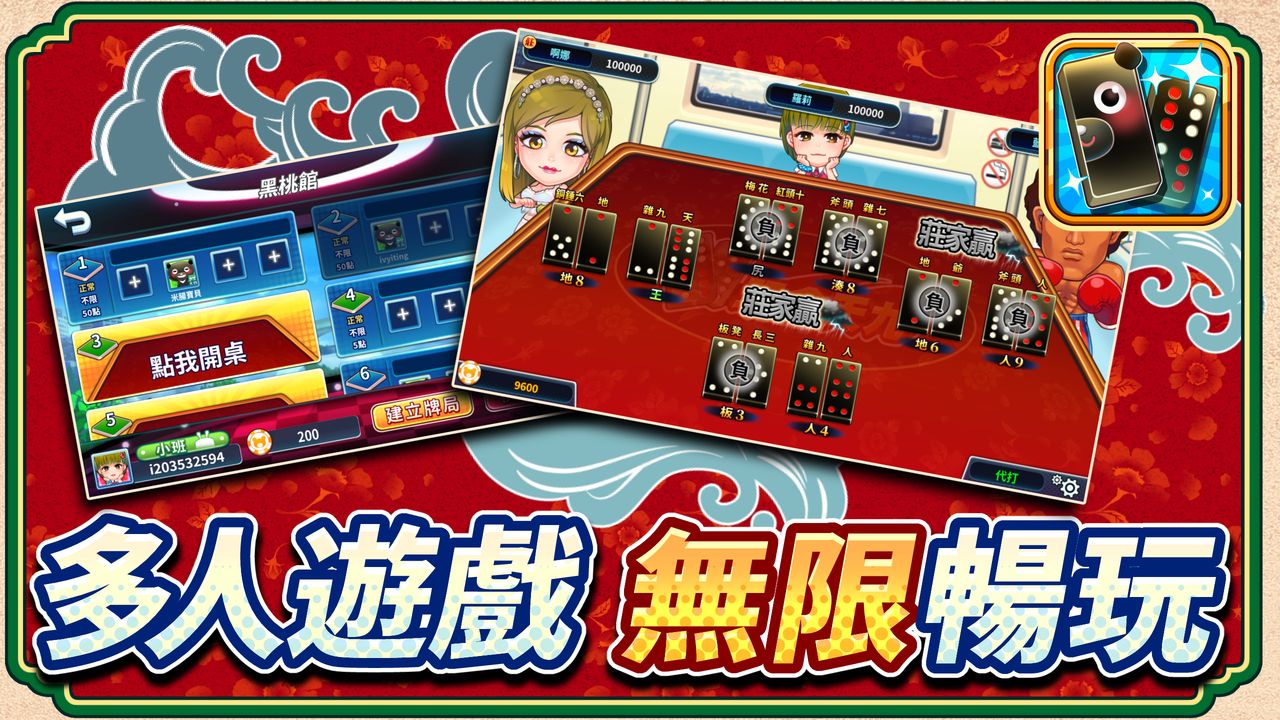
After players log in to the "iTaiwan Paigow" game lobby and select a suitable hall, they can click to enter that game hall. Inside the hall, players can select:
* Any empty seat, to immediately join a game that lacks players.
* Any empty table, to immediately enter the opening settings screen.
* Press Immediate Start, same as pressing any empty table. Immediately enters the new game settings screen.
* Press Auto Match, to display tables with current vacancies that the player can enter. The player can choose which game they wish to join.
PS. Players can enter any table with less than four people, but the prerequisite is to have at least 10 times the current round's bet. Also, the table must have no password restriction, or if it has a password, the entering player must possess the password.
Avatar Selection
iTaiwan Paigow" game provides players with many funny characters and voiceovers. After logging in, players can go to the Avatar Selection in the Member Center to set their in-game avatar.


Changing Nickname
When players apply to become a "iTaiwan Paigow" member, the modification method is the same whether you have an official nickname via full application or a temporary nickname via quick application. Players must log in via the official game website and change their nickname in the player data modification section.
精彩畫面
精彩畫面